
Copyright © Yanli He, PhD
Published by the California Institute of Applied Entrepreneurship (CalAE) on July 4, 2026
Abstract
As the United States commemorates the 250th anniversary of the Declaration of Independence in 2026, Americans have an opportunity to reflect not only on the nation’s remarkable achievements but also on the principles, people, and communities that have shaped its journey. Since July 4, 1776, the ideals of liberty, equality, and self-government have inspired generations both within the United States and around the world. This paper argues that freedom is not self-sustaining but depends upon moral responsibility, ethical leadership, entrepreneurship, and strong families. Drawing upon leadership theory, entrepreneurship research, and family studies, this paper examines three interconnected foundations of national longevity: (a) moral and ethical leadership as the foundation of freedom, (b) small business entrepreneurship as a manifestation of applied leadership and economic vitality, and (c) motherhood leadership as an essential force in cultivating future generations of ethical citizens and leaders. The paper concludes that America’s continued prosperity and democratic resilience depend on preserving both liberty and ethics, fostering vibrant small business development and startup innovation, and empowering motherhood leadership.
Keywords: freedom, ethical leadership, entrepreneurship, motherhood leadership, small business, civic engagement, organizational longevity
The Foundation of Freedom
Liberty cannot endure through laws and institutions alone, but depends upon a strong moral foundation, ethical leadership, and citizens committed to the common good. The United States Constitution opens with a shared aspiration to “establish Justice, insure domestic Tranquility, provide for the common defence, promote the general Welfare, and secure the Blessings of Liberty” (U.S. Constitution, pmbl.). These constitutional commitments require each generation to exercise freedom with integrity, accountability, and respect for the dignity of others. History demonstrates that nations flourish when their people uphold justice, safeguard democratic institutions, and balance individual liberty with the interests of the broader community (Putnam, 2000).
For many Americans throughout history, the foundation of freedom has also been deeply rooted in faith and God’s principles. Although the United States was founded upon the principle of religious liberty rather than the establishment of a national religion, biblical values, including obedience, honesty, integrity, compassion, humility, forgiveness, and stewardship have inspired countless individuals and communities to pursue justice, care for their neighbors, and serve the common good (Green & Robinson, 2022). As Scripture states, “For you were called to freedom … only do not use your freedom as an opportunity for the flesh, but through love serve one another” (Galatians 5:13, New International Version).
From a leadership perspective, leadership traits and ethics play a vital role in preserving freedom. They foster trust, encourage civic engagement, and inspire others to act with compassion, humility, and integrity. Even in today’s digital and AI-driven era, research has demonstrated that 16 leadership traits, including integrity, accountability, compassion, humility, and adaptability remain essential and contribute to virtual team longevity across nine measurable dimensions (He, 2023). Therefore, organizations and communities are sustained not merely by the exercise of freedom, but by the character and moral foundation of the individuals who comprise them.
Freedom and Small Business Entrepreneurship
Over the past 250 years, America’s development has been shaped not only by elected officials and public servants but also by parents, educators, entrepreneurs, volunteers, immigrants, and millions of ordinary citizens whose daily acts of service have strengthened civic life and community well-being (Putnam, 2000; Zong & Batalova, 2017). These contributions reflect a broader understanding of civic engagement in which social capital and community participation play foundational roles in sustaining democratic societies.
Among these contributors, small businesses have long served as a central pillar of the American economy. Small businesses account for a substantial share of job creation and innovation in the United States, particularly through new firm formation and entrepreneurial activity (Haltiwanger et al., 2013; U.S. Small Business Administration [SBA], 2023). Across generations, startups and small businesses have generated employment opportunities, introduced innovative products and services, revitalized local communities, and contributed to philanthropic and community development efforts.
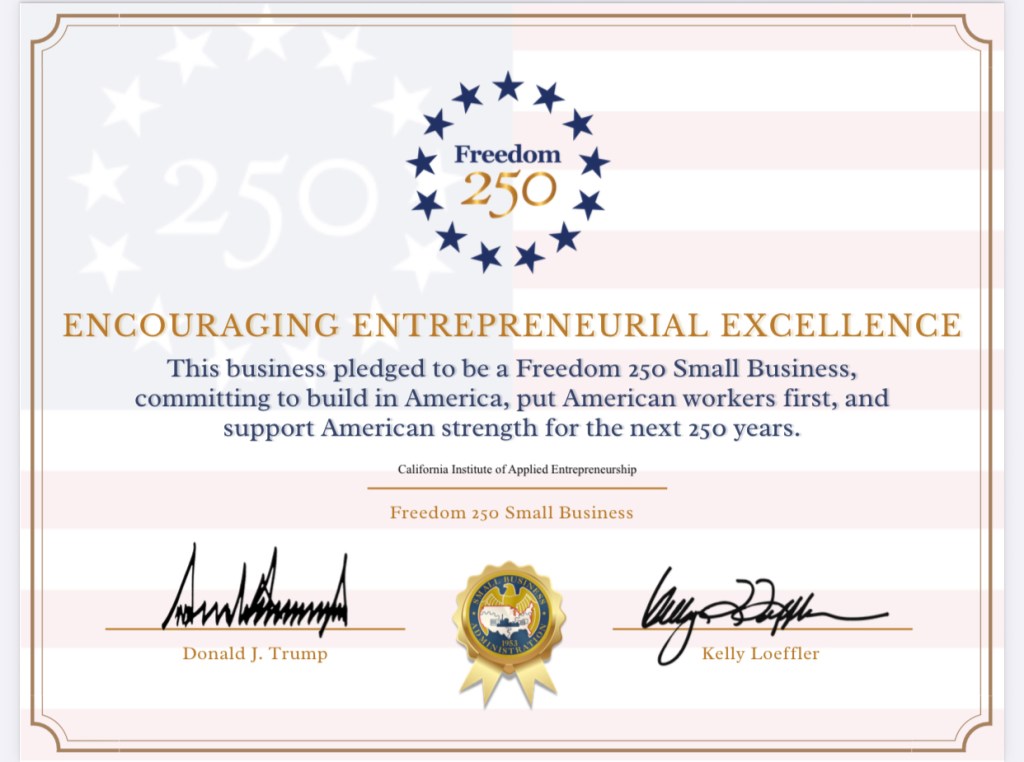
The California Institute of Applied Entrepreneurship has found that the contributions and influence of small business owners demonstrate that leadership is not defined solely by organizational size or formal authority but by the sustained and meaningful impact it has on employees, customers, and surrounding communities. In this sense, small business entrepreneurship becomes a form of applied leadership that contributes to both economic vitality and community resilience, thereby supporting the long-term prosperity and sustainability of the United States.
Freedom and small business entrepreneurship are deeply interconnected. The United States was founded upon the principle of individual liberty, the belief that individuals should have the right to pursue opportunity, make economic choices, and build enterprises based upon their own vision and effort (Hayek, 1944). This environment of freedom has created a unique ecosystem in which entrepreneurship can thrive with relatively low institutional barriers, enabling individuals from diverse backgrounds to transform ideas into businesses (Audretsch, 2007; North, 1990).
Moreover, freedom in the United States is not only economic but also social and institutional. The protection of property rights, access to capital markets, and the rule of law provide entrepreneurs with the confidence to invest in long-term growth (North, 1990; World Bank, 2020). Immigrants and first-generation founders have particularly leveraged this environment of freedom to pursue upward mobility and entrepreneurship, significantly contributing to innovation and business dynamism in the United States (Fairlie, 2012; Zong & Batalova, 2017).
Motherhood Leadership and the Future of America
Families are the first environments in which character is formed, ethics are taught, and values are transmitted from one generation to the next (Bronfenbrenner, 1979; Lickona, 1991). The strength and longevity of a nation ultimately depend upon the moral foundations established within its families and communities (Putnam, 2000). Research consistently demonstrates that parents, particularly mothers, play a significant role in children’s moral development, leadership capacity, emotional resilience, and long-term success (Bornstein, 2015; Maccoby, 2007).
Since its inception in 2024, the Global Motherhood Leadership Summit (GMLS) has highlighted the influence of mothers and families in developing ethical leaders, nurturing resilient children, and strengthening communities. GMLS integrates 16 core leadership traits into the context of motherhood, emphasizing the unique strengths and perspectives that mothers bring to families, workplaces, and society. Accordingly, Motherhood Leadership underscores how leadership traits and perspectives developed across both family and professional settings contribute to more effective and adaptive leadership practices. Likewise, leadership behaviors and skills cultivated in professional environments can empower mothers to resolve family conflicts, nurture healthy relationships, and lead with wisdom within the home.
As America enters its next chapter, the GMLS affirms that the nation’s future will be shaped not only by economic and political achievements but also by the leadership traits and ethical foundations cultivated within families. By raising children with strong moral values and a sense of responsibility, mothers help develop citizens and future leaders who sustain democratic institutions and advance the common good. By empowering mothers and strengthening families, society invests in the next generation of ethical leaders who will preserve freedom, enhance community resilience, and support the continued prosperity and longevity of the United States.
Conclusion
As the nation reflects on its first 250 years and looks toward the next century, the enduring success of the American experiment in self-government will depend upon its continued commitment to liberty, virtue, ethical leadership, entrepreneurship, and strong families. The ideals of freedom are sustained not merely by laws and institutions but by citizens who exercise their freedoms with responsibility and a commitment to the common good. In the words of the Preamble to the United States Constitution, the American people are called to “form a more perfect Union, establish Justice, insure domestic Tranquility, provide for the common defence, promote the general Welfare, and secure the Blessings of Liberty to ourselves and our Posterity” (U.S. Constitution, pmbl.). These aspirations remain as relevant today as they were in 1787 and continue to serve as a guiding vision for the prosperity, resilience, and longevity of the United States.
As America enters its next chapter, the future of the nation will be shaped not only by economic and political achievements but also by the leadership cultivated within families and communities, as well as by the entrepreneurial spirit that has long defined the American experience. By encouraging entrepreneurship and supporting small businesses, the nation invests in innovation, job creation, economic mobility, and local community development. Likewise, by empowering mothers and strengthening families, society invests in the next generation of ethical leaders who will preserve freedom, foster community resilience, and contribute to the continued prosperity and longevity of the United States.
The next chapter of America will be written not only by elected leaders and public institutions, but also by parents, educators, communities, and millions of entrepreneurs and small business owners whose daily acts of leadership, service, and innovation continue to strengthen the nation’s economic vitality and democratic foundations. By preserving both liberty and virtue, the United States can continue to secure the blessings of freedom for future generations.
References
Audretsch, D. B. (2007). Entrepreneurship capital and economic growth. Oxford Review of Economic Policy, 23(1), 63–78. https://doi.org/10.1093/oxrep/grm012
Bornstein, M. H. (2015). Children’s parents. In R. M. Lerner (Ed.), Handbook of child psychology and developmental science (7th ed., Vol. 4, pp. 55–132). Wiley.
Bronfenbrenner, U. (1979). The ecology of human development: Experiments by nature and design. Harvard University Press.
Fairlie, R. W. (2012). Immigrant entrepreneurs and small business owners, and their access to financial capital. U.S. Small Business Administration.
Green, J. C., & Robinson, C. (2022). Religion and the American presidency. Oxford University Press. https://doi.org/10.1007/978-3-319-62175-3
Haltiwanger, J., Jarmin, R. S., & Miranda, J. (2013). Who creates jobs? Small versus large versus young. Review of Economics and Statistics, 95(2), 347–361. https://doi.org/10.1162/REST_a_00288
Hayek, F. A. (1944). The road to serfdom. University of Chicago Press.
He, Y. (2023). A phenomenological study exploring the influence of leadership traits on virtual teams’ performance and sustainability to achieve longevity in Silicon Valley (Doctoral dissertation, Columbia International University). ProQuest Dissertations Publishing. https://www.proquest.com/docview/3171239117
Lickona, T. (1991). Educating for character: How our schools can teach respect and responsibility. Bantam Books.
Maccoby, E. E. (2007). Historical overview of socialization research and theory. In J. E. Grusec & P. D. Hastings (Eds.), Handbook of socialization: Theory and research (pp. 13–41). Guilford Press.
North, D. C. (1990). Institutions, institutional change and economic performance. Cambridge University Press. https://doi.org/10.1017/CBO9780511808671
Putnam, R. D. (2000). Bowling alone: The collapse and revival of American community. Simon & Schuster.
U.S. Small Business Administration. (2023). 2023 small business profile. https://www.sba.gov
World Bank. (2020). Doing business 2020: Comparing business regulation in 190 economies. World Bank. https://doi.org/10.1596/978-1-4648-1440-2
Zong, J., & Batalova, J. (2017). Immigrant entrepreneurs in the United States. Migration Policy Institute. https://www.migrationpolicy.org/research/immigrant-entrepreneurs-united-states


Leave a comment