
A Phenomenological Study Exploring the Influence of Leadership Traits on Virtual Teams’ Performance & Sustainability to Achieve Longevity in Silicon Valley
As the world has entered a dynamic, digital, and Artificial Intelligence (AI)-driven era following the COVID-19 pandemic, virtual teams have transitioned beyond traditional global and temporary structures to adopt local, permanently virtual, and hybrid (in-person and virtual) work models across various industries. Therefore, exploring effective leadership strategies to ensure the longevity of virtual teams has become both necessary and meaningful. While it is widely understood that leaders’ personalities, character, and ethics impact teamwork, the specific ways in which leadership traits influence the performance and sustainability of virtual teams in today’s dynamic, digital, and AI-driven era remain unknown.
To address this, Dr. Yanli He conducted a qualitative phenomenological study exploring how leadership traits influence virtual teams’ performance and sustainability, particularly in achieving longevity in Silicon Valley. From 2021 to 2023, she spent three years drafting her dissertation and interviewing 12 virtual team leaders and members in Silicon Valley. She then dedicated an additional year to refining her research in collaboration with the APA stylist team. On February 28, 2025, this transformative study was published on ProQuest. Link to this study
Findings
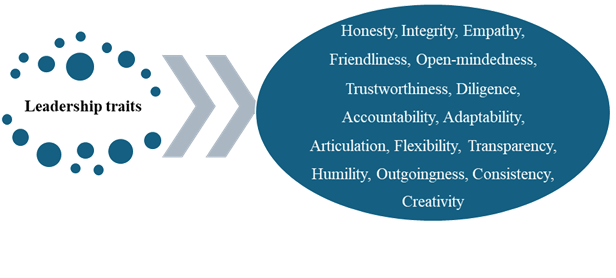
- First, the study identified 16 common leadership traits essential for virtual team settings. Among the 33 leadership traits described by participants, more than half of the 12 participants shared these 16 traits as necessary for virtual teams, including honesty, integrity, empathy, friendliness, open-mindedness, accountability, adaptability, articulation, flexibility, trustworthiness, transparency, humility, outgoingness, diligence, consistency, and creativity (see Figure 3).
Figure 3
Most Common Leadership Traits Mentioned by Participants
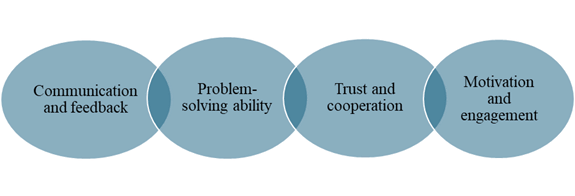
- Second, the findings revealed that leadership traits collectively influence virtual teams’ performance in four themes: (a) communication and feedback, (b) problem-solving, (c) trust and cooperation, and (d) motivation and engagement (see Figure 5).
Figure 5
Themes From Research Question2
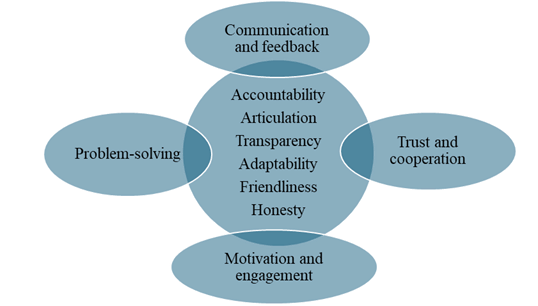
More specifically, the study identified the most influential leadership traits essential for the effective performance of virtual teams, including accountability, articulation, transparency, honesty, integrity, adaptability, outgoingness, supportiveness, listening, democracy, appreciation, encouragement, open-mindedness, and empathy. These traits impact at least two of the four key aspects of virtual teams’ effective performance. Figure 6 illustrates some top influential leadership traits and their influence on virtual teams’ effective performance.
Figure 6
Top Influential Leadership Traits & Their Influence on Virtual Teams’ Effective Performance
Impressively, each trait and its influence on virtual teams’ effective performance was supported by an original quotation included in the study. For example, as for the influence of transparency on effective communication and feedback,
“The findings of the study indicated that transparency enables leaders first to turn on the video in the virtual meeting, help team members clearly understand their leaders’ expectations, and get 100% feedback on their weaknesses through transparent communication. As Participant 8 shared,
I asked my friend, ‘What is the best way to get people to turn on the cameras?’ The friend preferred that I first turn on my camera transparently. So, I turned on my camera and acknowledged people when they logged in, which helped a lot with communication.
Participant 12 explained: ‘Transparency about what is expected and what are the deadlines [of the projects] is required for effective communication and feedback.’ Moreover, Participant 4 shared a positive example of transparency:
I attended a meeting with the other team. The leader of the other team gathered some feedback from her team members about me and shared that feedback with my manager. Then, my manager shared everything with me without hiding, being 100% transparent about the feedback. Although some feedback was hard to take, my manager and I reviewed each feedback and focused on what kind of action I should take to improve. So, this transparency helped me to understand my weaknesses, and [it] motivated me” (He, 2023, p. 105).
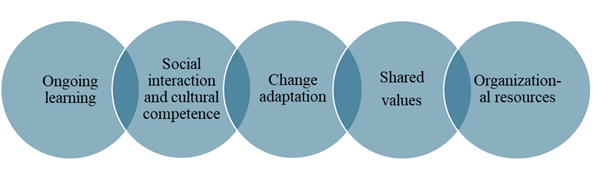
- Third, the findings revealed that leadership traits collectively enhance virtual teams’ sustainability in five themes: (a) ongoing learning, (b) social interaction and cultural competence, (c) change adaptation, (d) shared values, and (e) organizational resources (see Figure 7).
Figure 7
Themes From Research Question 3
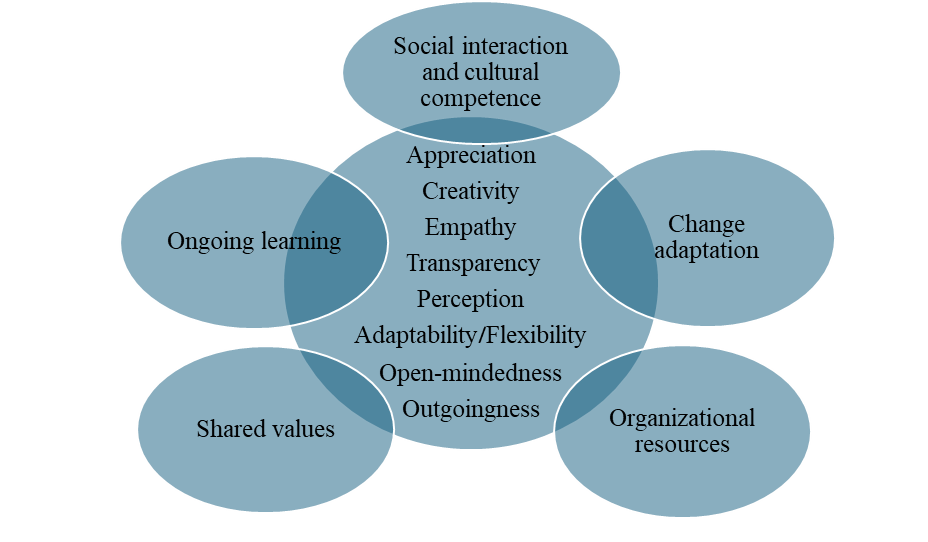
Likewise, the study distinguished the most influential leadership traits needed for virtual teams’ sustainability, including appreciation, creativity, empathy, transparency, perception, adaptability, democracy, open-mindedness, and outgoingness (See Figure 8).
Figure 8
Most Influential Leadership Traits & Their Influence on Virtual Teams’ Sustainability
Similarly, each trait and its influence on virtual teams’ sustainability has the original quotation included in the study. For example, as for the influence of outgoingness on virtual teams’ social interaction,
“The findings of the study indicated that an outgoing personality makes leaders relaxed and optimistic when leading a virtual call with a strong voice, enables leaders to invite team members to share opportunities for socializing in virtual settings during work breaks, and brings positive energy to virtual teams. As Participant 7 said, ‘I would say her [the leader’s] personality, in general, is very happy-go-lucky. When she hops on a call, she has a strong voice. So, you [team members] know she is the one leading the call.’ Moreover, Participant 5 shared a positive example of an outgoing personality in virtual social interaction:
I remember that at one of the companies I [worked for], they [leaders] hosted virtual happy hours and virtual game nights. So, these were two ways that they were able to maintain social interaction even though it was virtual. At 3:00 PM or some other random time, [team members] could grab their own drink and create a meeting room [where] everyone could chat with each other. Basically, it [virtual happy hours] was still within your [team members’] own home, but at the same time, it allowed for social interaction by refraining [team members] from speaking about work topics. It was not work time, even though it was a work-sponsored event. I think the person who organized it [virtual happy hours] was pretty outgoing.
Participant 2 further commented, ‘If he [the leader] is outgoing and friendly, he will also bring positive energy to the team.’ Moreover, the findings of the study indicated that an outgoing personality could promote social activities and prevent team members from feeling isolated in the virtual world. As Participant 11 said, ‘If a leader is outgoing, it will help him [or her] to set up social interaction easily. If he himself has that kind of character [outgoingness], he needs it [social interaction] as well, right?’ Participant 2 further said,
The personality of the leader also [needs] to be very sociable and outgoing. Otherwise, if he [the leader] does not even want to meet in person, you [the team members] will probably start to feel isolated from the rest of your team” (He, 2023, pp. 129-130).
Contributions
By integrating these findings, this research successfully applied leadership traits theory to virtual teams and fills a gap in scholarly literature by providing a comprehensive and systematic analysis of the influence of leadership traits on virtual teams’ longevity in today’s digital and AI-driven world. Moreover, the study revealed that leadership traits serve as the foundation for effective leadership, as different traits lead to different leadership behaviors, styles, dynamics, and relationships in virtual team settings. Through Dr. Yanli He’s dissertation, leadership traits have re-emerged in today’s dynamic, digital, and AI-driven era, serving as a fundamental component of ethics and the security of AI sustainability. Therefore, Dr. Yanli He can be regarded as the Godmother and a leading authority on leadership traits in virtual teams in the modern virtual, digital, and AI-driven workspace.
Dedication & Sacrifice
To seek such a comprehensive understanding of leadership traits and a deeper analysis of the data, each transcript was carefully reviewed at least four times and manually coded and analyzed in a very diligent, honest, and accountable manner. Such dedication ensured the data’s accuracy, rigor, and objectivity. As a result, the influence of each leadership trait on virtual teams’ longevity is supported by original quotations presented in the current dissertation.
As Dr. Yanli He stated:
“When I was analyzing the data, my motivation was not just to fulfill a dissertation requirement or earn a Ph.D. degree, but to be accountable to all the participants for their insights. I saw myself as a chef because when a good chef has all the ingredients on hand, he or she must carefully study their features and functions, make the best use of them, and create the best dish that is accountable to the customers.”
To cover the research expenses, Dr. Yanli He worked multiple part-time jobs at a boba tea shop, a Japanese sushi restaurant, and a banner shop in the San Francisco Bay Area during 2022–2023. To save time, she often slept in her office, the research site in Palo Alto, as she frequently finished work after midnight.
As She shared:
“During the last six months of writing my dissertation, I worked on my business and part-time jobs during the day. In the evenings, I wrote my papers until 3 or 4 a.m. By that time, I was too exhausted to safely drive 25 minutes from my Palo Alto office to my home in Santa Clara, so I chose to sleep in the office. Because I spent thousands of nights in the office since 2021, I met the cleaning lady twice each night, and we chatted and eventually became friends. I even joked that if I ever died in the office, she would be the first one to know.”
A Testimony to God’s Purpose
As a new immigrant to the U.S. in her late 30s with limited English proficiency at first, Dr. Yanli He faced immense challenges in the beginning. Yet, through faith, diligence, continuous learning, and creativity, she overcame obstacles and achieved what once seemed impossible. Once again, God used an ordinary person to accomplish something extraordinary. As Dr. Yanli He acknowledged:
“To my Lord and Savior Jesus Christ, I gratefully thank you for helping me light the hope, reinforce the morale, and gain the courage to step out in faith on an incredible new beginning in the United States. To my school, Columbia International University, thank you for providing me with a high-quality education. As a Christian university graduate, I am not merely a doctor in organizational leadership but a steward with a higher standing of ethics, which is the foundation to do extraordinary things.”
Sharing This Research with the World
The results advanced a practitioner’s knowledge in terms of leadership traits theory, virtual team leadership, and virtual teams’ longevity. The findings first validated the concept and strengths of leadership traits as discussed in the literature. Second, the findings advanced the importance of leadership traits and could boost practitioners’ confidence in applying leadership traits across various team types. We hope this work benefits individuals, groups, and organizations navigating the digital landscape and inspires others to pursue their dreams in the United States, following Dr. He’s example.
Our prayer is that God will use this dissertation for His glory as you share it with others! See this study
He, Y. (2023). A phenomenological study exploring the influence of leadership traits on virtual teams’ performance and sustainability to achieve longevity in Silicon Valley (Publication No. 31839102) [Doctoral dissertation, Columbia International University]. ProQuest Dissertations & Theses Global.
Acknowledgments
We gratefully thank all the professors, peers, the APA stylist team, and Dr. He’s family who mentored, supported, and witnessed this transformative journey:
- Dr. Lorna-Michel Wright
- Dr. Clifford W. Churchill
- Dr. Jimmy L. Dolson
- Dr. Marybeth Leavell
- Dr. Rick Christman
- Dr. Brian Simons
- Dr. Kera Gentle-Brake
- Bi He (Dad) / Qian Chen (Mom)
- Dehui Zhang (Grandmom, who passed away)
Post-Pandemic Leadership Research Institute
🌍 www.leadershipPhD.org
📩 we@leadershipPhD.org
References
He, Y. (2023). A phenomenological study exploring the influence of leadership traits on virtual teams’ performance and sustainability to achieve longevity in Silicon Valley (Publication No. 31839102) [Doctoral dissertation, Columbia International University]. ProQuest Dissertations & Theses Global. https://www.proquest.com/docview/2133944576
 Post-Pandemic Leadership Research Institute
Leave a comment